Leadtime: Evaluating Total Cost of Ownership — Wholesale Programme Notes
VapeWholesaleHub Leadtime · Leadtime OEM and private label
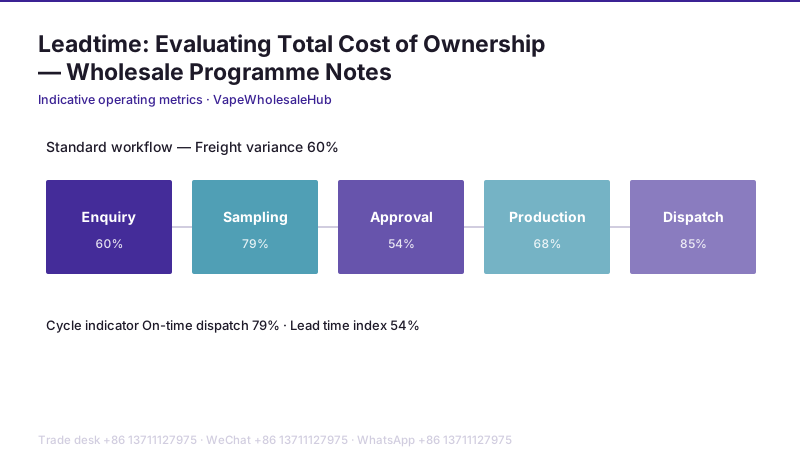
Distributors working with Leadtime rarely lose money on a single bad order. They lose it on the slow leaks: a spec sheet nobody read, a pallet held at customs for nine days, a line that quietly fell out of favour while the reorder was still on the water. This page looks at leadtime: Evaluating Total Cost of Ownership — Wholesale Programme Notes from the angle that matters to a buyer, not a brochure.
Where the supply actually comes from
Sourcing decisions around leadtime: Evaluating Total Cost of Ownership — Wholesale Programme Notes are usually made on price and then regretted on consistency. The input changes, the tolerance drifts, and suddenly the line that sold through in March behaves differently in July. Locking the input specification in writing is the cheapest insurance a wholesale buyer can buy.
On the sourcing side, leadtime: Evaluating Total Cost of Ownership — Wholesale Programme Notes comes down to how much of the chain you can see. A trading desk that only ever talks to a sales rep is buying on faith. We prefer accounts that ask for the factory audit, the mixing records and the batch numbers, because that paperwork is what protects everyone when a shipment is questioned later.
The commercial side of the decision
Commercially, leadtime: Evaluating Total Cost of Ownership — Wholesale Programme Notes rewards buyers who think in turns rather than in unit cost. A slightly higher price on a line that sells through twice as fast is better money than a cheap line that occupies shelf space and working capital for two seasons.
The accounts that grow steadily on leadtime: Evaluating Total Cost of Ownership — Wholesale Programme Notes tend to do one boring thing well: they reorder before they run out. It sounds obvious. In practice, most wholesale buyers reorder late, pay for expedited freight, and then blame the supplier for the cost.
What quality control looks like in practice
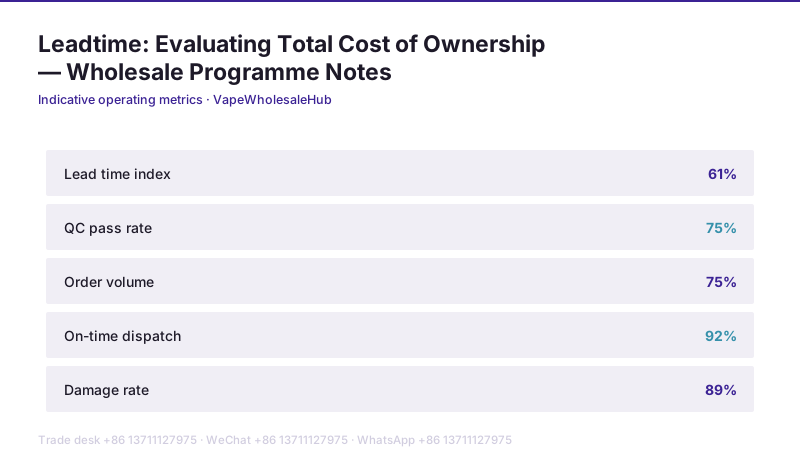
Quality control on leadtime: Evaluating Total Cost of Ownership — Wholesale Programme Notes is unglamorous and repetitive, which is exactly why it works. Incoming inspection, fill weight checks, leak testing and a retained sample from every batch. None of this is clever; all of it is cheaper than a recall.
The failure modes in leadtime: Evaluating Total Cost of Ownership — Wholesale Programme Notes are predictable once you have seen enough of them. Seals that relax in heat, tolerances that drift after a tooling change, inputs that separate in transit. Testing for the known failure modes catches roughly ninety percent of what would otherwise reach a customer.
Freight, packaging and landed cost
Packaging is part of logistics, not marketing. Cartons for leadtime: Evaluating Total Cost of Ownership — Wholesale Programme Notes need to survive stacking, humidity and a forklift operator having a bad Monday. We specify board grade and pallet pattern before we talk about print finish, because a damaged pallet costs more than any artwork upgrade recovers.
Freight for leadtime: Evaluating Total Cost of Ownership — Wholesale Programme Notes has its own rhythm. Peak season rates, holiday closures and carrier capacity all move the landed cost in ways that a unit price sheet never shows. We plan replenishment backwards from the shelf date rather than forwards from the order date, and it removes most of the surprises.
Order structure at a glance
| Item | Standard | Volume | Programme |
|---|---|---|---|
| Typical order unit | Master carton | Pallet | Full container |
| Documentation | COA + SDS | COA + SDS + batch record | Full technical file |
| Lead time | 2-4 working days | 5-10 working days | 15-25 working days |
| Customisation | Label only | Label + closure + bottle | Full OEM / ODM |
| Sampling | Charged, credited on order | Included in development | Multi-round approval |
| Indicative MOQ | 1200 units | 6,000 units | 24,000 units |
| Development window | n/a | 3-5 working days | 3-5 + approval |
Common questions
What is the usual minimum order quantity?
Minimum order quantity depends on the line. Standard stock items typically start at a single master carton, while custom work, private label artwork and bespoke tooling carry higher thresholds because the setup cost has to be recovered. We publish the figure for each line rather than quoting one blanket number.
Do you offer private label or OEM production?
We do. Private label covers artwork, bottle and closure choice on existing formulations. OEM and ODM work goes further into housing, tooling and exclusive development, with confidentiality agreements in place before any formulation detail is shared.
What shelf life should we plan around?
Unopened e-liquid is typically stable for around two years when stored cool and away from direct light, and device batteries lose capacity on a similar curve. We print manufacture dates and batch codes on every unit so stock rotation is straightforward.
Related reading
- Leadtime and mould ownership in Contract Supply — New Account Setup
- Leadtime Vape Supply Notes 1544
- Leadtime and Shelf Life: Storage Guidance — Franchise Network Guide
- Leadtime Vape Supply Notes 903
- Leadtime and End of Line Clearance — Wholesale Programme Notes
- Building Compliance Files for Leadtime Lines — Cash and Carry Notes
Talk to the wholesale desk. Specifications, MOQ, stock and freight options for leadtime: Evaluating Total Cost of Ownership — Wholesale Programme Notes.
Phone +86 13711127975 · WeChat +86 13711127975 · WhatsApp +86 13711127975